Building
Yorkville History
The first home in this area was erected shortly before the American Revolution by Jacob Walton, a wealthy trader, whose family was one of the social leaders of that day. In 1776 his residence was taken over by the Continental Army and converted into a fort. Bombed by British warships, it was captured and occupied as a British Army camp until 1783.
Archibald Gracie, a world-famous merchant whose trading vessels sailed the seven seas, purchased the property in 1799 and built a palatial mansion here. Hence the name Gracie Mansion. More recently, when contemporary New Yorkers wished to select a suitable official residence for the Mayor of New York, this site was chosen, the mansion refurbished, and was occupied by the late Fiorello LaGuardia as the first official occupant.
Other prominent Americans, such as Alexander Hamilton, John Jacob Astor, and others, established homes in this residential area.
The construction of the Boston Post Road and the New York and Harlem Railroad through the Upper East Side encouraged development around what is now 86th Street, which expanded outward.
By 1850, a significant proportion of the inhabitants were Germans and Irish who helped construct the Croton Aqueduct. After the Civil War, mansions began to replace slums, and around this time the area came to be referred to as Yorkville.
The construction of elevated train lines along Second and Third Avenues in the 1870s and 1880s further spurred development and attracted an influx of residents.
For much of the 19th and into the 20th century, Yorkville was mostly a German enclave of middle- and lower-class families, although Eastern European immigrants also called Yorkville home. By the late 1920s, however, Yorkville started to become less diverse, as many Germans began to move to other neighborhoods and the suburbs. The demolition of the els contributed to this change, as high-rise apartments replaced ethnic businesses and Yorkville became more gentrified.
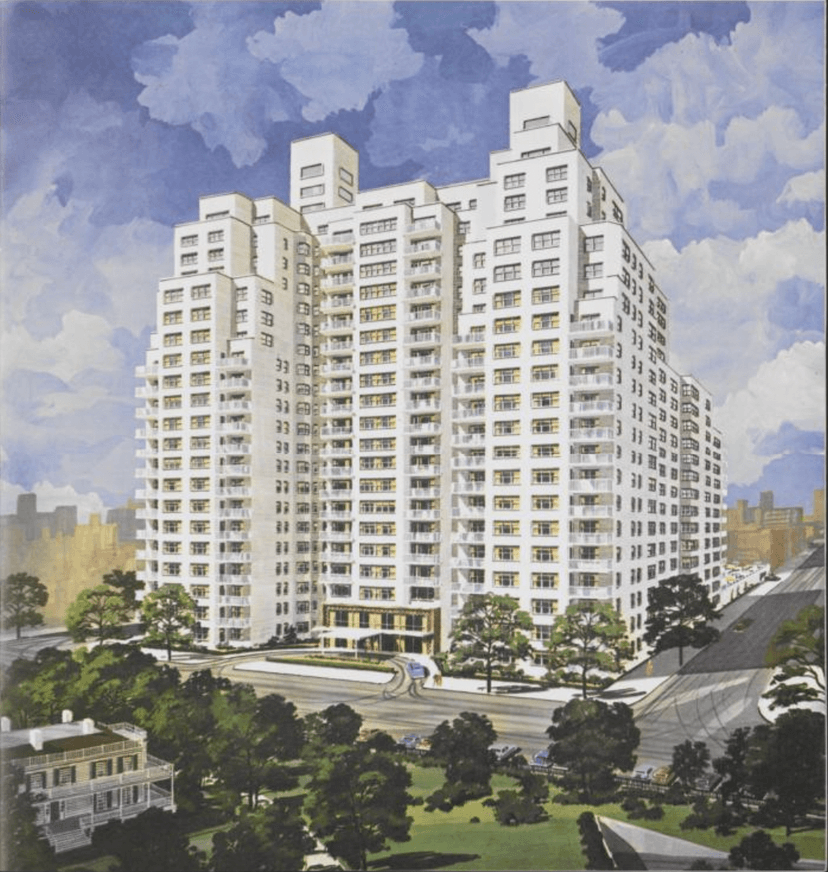
The 180 East End Avenue Corporation was incorporated for the purpose of acquiring property and constructing a cooperative building on land located between 88th and 89th Streets. An initial mortgage was obtained in the amount of $950,000 to purchase property from Vincent Astor, great-great-grandson of John Jacob Astor. Eventually a total of $1,250,000 was spent on land acquisition. Construction on the building commenced in 1959 and was completed in 1961, at a total cost of $8,739,310.